
Quality Control in Manufacturing Explained

Quality control is a critical part of manufacturing, but when checks are inconsistent or issues are only found late in production, it can quickly lead to rework, delays, and pressure on the shop floor. Building quality checks into the production process helps manufacturers apply standards more consistently without relying on operators to catch every issue manually.
In this article, we’ll explain why quality problems happen in manufacturing and the practical steps manufacturers take to improve production consistency.
Is Your Production Process Consistent?
Use the checklist to identify where checks are missed, standards vary, or issues are picked up too late.

Where Quality Control in Manufacturing Breaks Down
Quality control becomes difficult when checks are separated from the production process itself.
Checks are often completed after work is finished instead of at the correct stage. Operators may follow different methods for the same task, paperwork is completed inconsistently, and issues are only discovered during final inspection or testing. By that stage, products may already need rework or additional investigation to understand where the problem occurred.
As production pressure increases, teams often rely on experienced operators to spot mistakes manually or remember what should happen next. Over time, this creates more variation between shifts and makes production harder to control consistently.
This is why quality problems are rarely just inspection problems. In most cases, they come from inconsistent production control across the process itself.
Is Quality Applied Consistently Across Production?
Use the checklist to define clear standards and make sure they’re applied consistently at each stage.
Step 1: Identify Where Issues Actually Occur
Start by looking at where quality problems are already affecting production. This is usually where products repeatedly fail inspection, operators stop work to correct issues, or assemblies are sent back for rework.
These points often show where production control is weakest and where additional checks or clearer guidance will have the biggest impact. Focus first on the stages where mistakes happen regularly or where issues become more expensive to correct later in production.
Step 2: Define What Good Looks Like
Once the highest-risk stages have been identified, the next step is making quality expectations clear and easy to apply consistently on the shop floor.
Operators should understand exactly what they are checking, what acceptable looks like, and when work should not move forward. Clear work instructions, tolerances, and visual guidance help remove interpretation from the process and make quality easier to apply consistently across shifts.
Step 3: Build Quality Checks Into Production
Quality checks are most effective when they happen at the correct stage rather than at the end of the process.
If inspections only happen at the end of the process, problems can move through multiple stages before they are identified. Building checks directly into production allows operators to complete required checks as work is carried out, improving consistency and making issues easier to correct before they affect the rest of production.
Information is also captured during the build itself, improving traceability and reducing reliance on handwritten notes or information recorded afterwards.
Step 4: Make It Repeatable Across Shifts
Quality control becomes difficult when different operators follow different methods for the same process. Variation between shifts often comes from relying on memory, experience, or informal ways of working rather than a repeatable process.
The goal is to make quality checks consistent regardless of who is carrying out the work. Clear instructions, standardised checks, and defined production sequences help create a more predictable process where quality is supported by the system itself rather than depending on experienced individuals to catch mistakes manually.
What Good Quality Control Looks Like in Practice
When quality control is built into production, issues are identified earlier before they move further through production. Operators follow a clearer process, checks happen at the correct stage, and problems are easier to correct before they affect the rest of the build.
This creates fewer rework loops, more consistent output between shifts, and better visibility across production. Traceability records are captured during the build itself, making audits easier to manage and reducing the need to piece information together afterwards.
Day to day, production becomes easier to control with less time spent firefighting quality issues later in the process.
Moving Beyond Manual Quality Control Processes
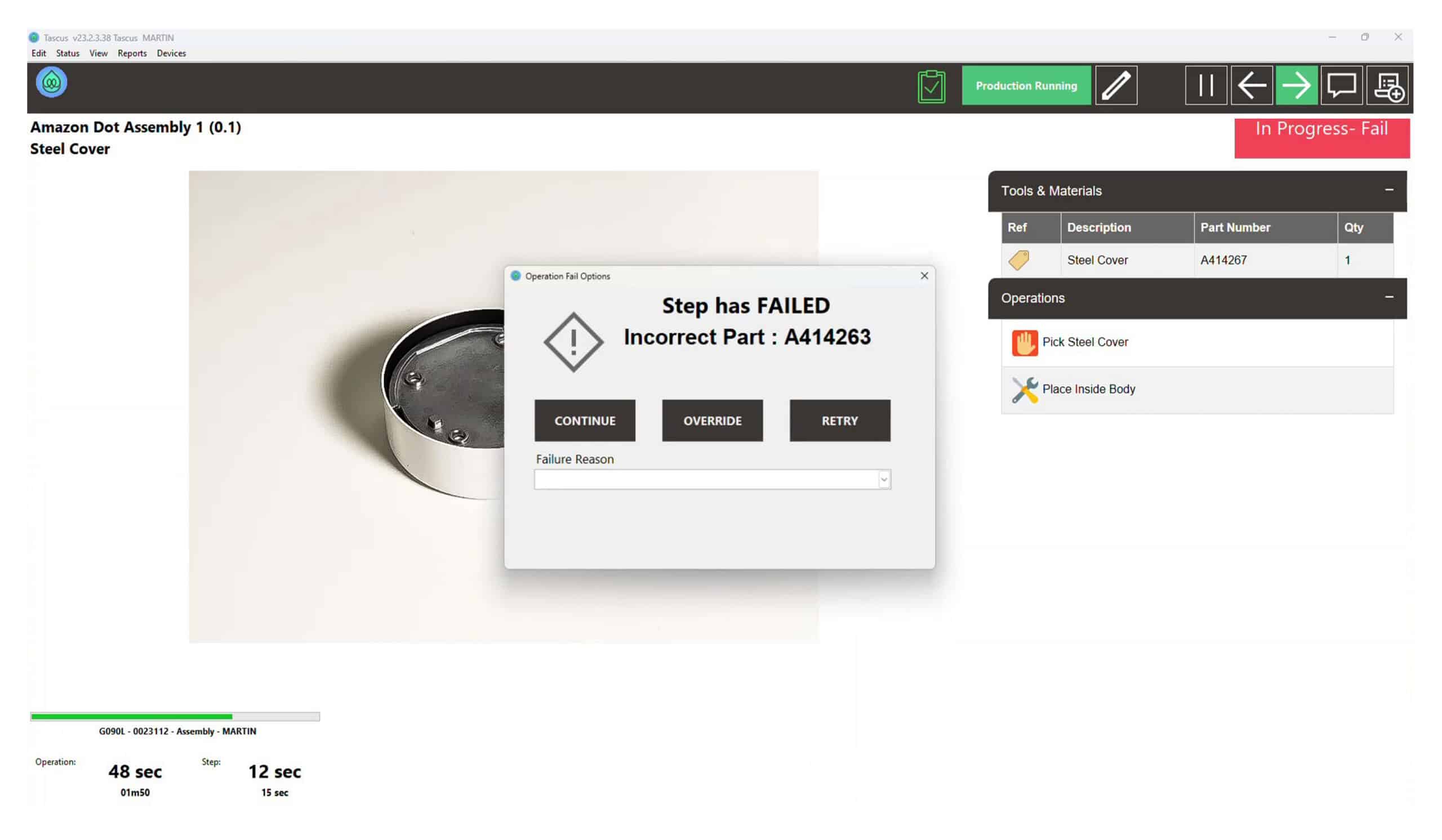
Tascus built in quality checks screenshot
Quality control becomes harder to manage consistently when production relies on paper travellers, spreadsheets, and disconnected records. Checks may be completed differently between operators, information is often recorded afterwards, and production teams have limited visibility into what has happened during production.
This is where workstation-level systems like Tascus are used to build quality directly into the production process.
Tascus guides operators through the correct sequence, applies checks at the correct stage, and captures production records at each stage of the process. This helps manufacturers reduce variation between shifts, improve traceability, and maintain more consistent control across production.
Talk through your
production process
Discuss how production currently runs, where issues are
appearing, and what’s making consistency
harder to maintain.